Designing a practical farm layout
A thoughtful layout saves time every in-game day and makes your farm more pleasant to explore. This guide covers paths, grouping and planning for future growth.
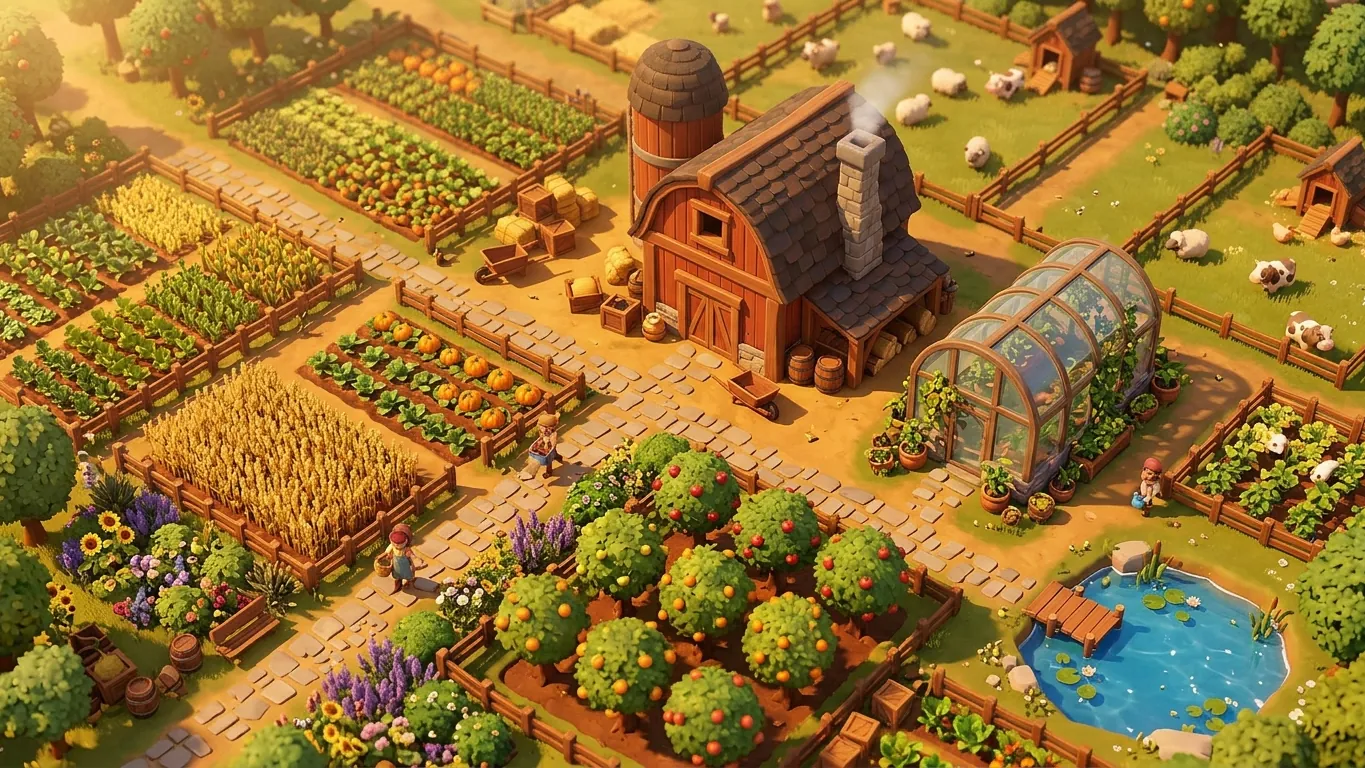
Start with paths
Paths are the skeleton of a farm. Before placing fields or buildings, think about how your character will move around each day. The most frequent route usually runs from your house to your fields, then to animal buildings and finally to the exit toward town or the fishing spots.
Keeping these routes short and direct saves time across many in-game days. In some games, paths also speed up movement or prevent weeds from growing, which makes them doubly useful. Even if your game treats paths as purely decorative, they help you organize space and make the farm easier to read at a glance.
Group by task
A practical layout groups things you use together. Crops that need daily watering can sit near a water source. Processing machines can be placed between fields and storage so that harvested goods move in one direction. Animal buildings work well clustered with their feed storage and grazing areas.
Grouping reduces backtracking. Instead of walking across the farm several times, you complete one area and move on to the next. Many players find that a farm divided into zones, such as crops, animals, processing and decoration, is easier to manage and expand than one where everything is scattered.
Leave room to grow
Early in a game, your farm may be small, but it rarely stays that way. New buildings, larger fields and additional machines tend to appear as you progress. Leaving open space near your core areas makes these additions easier to place without rebuilding everything.
It can help to sketch a rough plan, either on paper or mentally, showing where future buildings might go. You do not need to follow it exactly, but having a direction prevents situations where a perfect spot for a new barn is blocked by a row of trees you planted on day three. Many games allow you to move buildings later, but checking whether yours does is worthwhile before committing.
A simple layout planning process
These steps can be adapted to almost any farming game.
- 01
Map your daily route
Identify where you start each day and where you usually need to go.
- 02
Place core paths
Lay down main paths along that route before adding anything else.
- 03
Define zones
Decide where crops, animals, machines and storage will live.
- 04
Reserve open space
Keep empty areas next to each zone for future expansion.
- 05
Review and adjust
After a few in-game weeks, notice what slows you down and refine the layout.
Make it your own
Efficiency is useful, but a farm is also a personal space. Many players spend as much time decorating as they do farming, adding fences, flower beds, lanterns and seating areas. These touches do not always provide practical benefits, yet they make returning to the farm each day more enjoyable.
There is no single correct layout. Some players prefer strict grids with every tile used, while others build winding paths and wild gardens. A good layout is simply one that supports the way you like to play. Start practical, then let the farm grow into something that feels like home.
Related articles
 Fishing game basics: cast, hook and reel
Learn how fishing mechanics usually work in video games, from casting and the hook set to reeling and managing line tension, with a simple practice routine.
Read more
 Planning your first season on a virtual farm
A practical guide to your first season in a farming game: starting small, using energy and time well, and saving resources for the season that follows.
Read more